


 |
| Source: PBS |
It can be challenging to explain the cultural and revolutionary dynamics in Syria without getting pinned into a “should we or shouldn’t we” intervention choice. At the same time, we found it disconcerting that three different kids in three different classes asked whether the President’s actions toward Syria would lead to World War Three. After a bit of questioning, it turned out they were all responding to a misquoting of remarks by the Syrian deputy foreign minister that had been hyped by cable news.
The syrian conflict, in 5 minutes from BOMBILLO AMARILLO ® on Vimeo.
Luckily, a host of trustworthy visual resources exist to help kids learn about Syria. These can fit into any course subject, from a social history of the tension to the science behind chemical weapons. Students can then make up their own minds regarding U.S. involvement.
The animated video above is the perfect place to start in letting students learn about the history of the conflict. Created by Wilson Liévano and designed by Bombillo Amarillo in association with Animated Press, the motion graphic is informative and age-appropriate. It offers a complete cultural timeline and an explanation of Bashar al-Assad's reactions to rebel resistance.
 |
| Source: The New York Times |
For lesson plans and teacher tools, PBS lives up to its reputation for objective reporting with a "cheat sheet" of regional facts and a "What Would You Do?" simulation. The news site is an invaluable repository of classroom resources.
 |
| Source: Al Jazeera |
The New York Times also presents an interactive feature on the "Evolution Of Syria's Conflict." It dates from last year, but it lays out some strong background details on the roots of the war. For infographics about possible partners in a military intervention, Visual.ly has gathered a helpful library of images, including the one above from Al Jazeera.
 |
| Source: PBS Newshour |
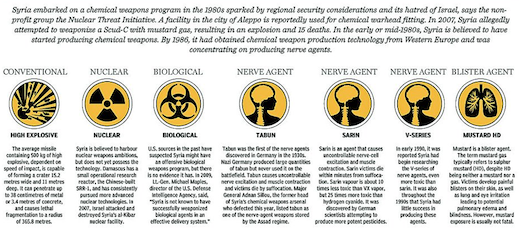
Chemical weapons are bound to come up in conversations with students, because the President drew his "red line" at their use. Kids also worry about their gruesome effects. One approach to this discussion is via science. The diagram above from PBS Newshour outlines technology to survive possible exposure. Richard Johnson at the National Post also offers a detailed graphic that explains the different types of chemical agents that Syria might employ.
 |
| Source: National Post (full image) |
Finally, refugees fleeing the Syria devastation are perhaps the most critical but least reported story. The video below from Simon Rawles, entitled "Syria's Lost Generation," is a good one to share with students, because it highlights the displacement and suffering of children their own ages and younger.
Syria's Lost Generation? from Simon Rawles on Vimeo.


